A recent Forrester research paper by Stefan Ried examines how new RIA Ajax based applications are being accepted in the business community.
Stefan notes that "a great user experience is one of the most compelling and important characteristics of a modern business application." As Ajax based business applications are becoming more common his research shows that their interfaces tend to frustrate powers users. Power users are used to high performance extremely interactive client-server applications and are easily frustrated by Ajax based applications.
Stefan details a list of Ajax's shortcomings as a platform for enterprise business applications. These include slow performance, inability to deal with large complex displays and inconsistency between browser platforms.
To all you Ajax folks who have experienced these shortcomings first hand, you should check out Curl! Curl offers the high performance of client-server applications, easily handles complex displays with large datasets and runs on Windows, Linux , Mac. It's easy to Get Started Now.
On Tuesday we will announce the release of the Curl Web Services Development Kit - WSDK. Yesterday I briefed Paul Krill of InfoWorld on the announcement and he wrote this article.
This announcement is significant to Curl for a couple of reasons.
This is our first Open Source product. - Back in October of last year we contributed 3 components to Open Source. This was the first step in our open source strategy. We will continue to contribute key components of the product that help support rapid development of enterprise-class RIAs to Open Source . Now we have completed the integration and testing of the Curl WSDK and will offer it as a fully supported component of our RIA Platform.
The WSDK links Curl RIA applications directly to SOA - As enterprises continue to execute on their SOA strategy they are increasingly seeing the need to present and visualize large complex data sets on the client. Untill recently complex business processing and data manipulation has been a server side task. Now with RIAs more processing can happen on the client enabling much more responsive and dynamic applications. The WSDK provides the functions to enable direct connection to SOA back-end data.
The WSDK provides a simple way to use web services directly in Curl applications. You are can obtain information resources from a Service Oriented Architecture though SOAP and WSDL, or from a Resource Oriented Architecture though REST and XML.
SOAP Web Services described using WSDL are processed by the WSDK and converted directly into Curl packages and class definitions, which can be used just like any other Curl application component. The service definitions can be processed programmatically, or using a tool in the Curl IDE.
Additionally the WSDK XML Document Model (XDM) provides functionality for processing XML data in Curl: reading, creating, modifying and writing XML documents. XML document contents are represented as a hierarchy of Curl objects. The objects can be accessed using methods and by XPath expressions. They can be displayed, transformed into other Curl representations, and used as a basis for data binding.
In traditional Web environments, Web services and resources are usually consumed by other Web servers. The full potential of web data can be realized using Curl’s rich client environment. Curl clients can directly consume Web services since the Web service technology stack is embedded in the runtime platform. This allows for dynamic presentation and direct interaction with the information resources.
With the release of the Technology Study we commissioned from Sonata it is now clear that there is a spectrum of RIA technologies that serve the diverse needs of Internet applications. These needs define a spectrum from simple B2C interfaces to the more complex highly visual interfaces of real-time dashboards.
We have created the following graphic to position the RIA technologies along a spectrum from B2C to B2E and B2B.
From the moment I first heard of Curl it was clear to me that it was uniquely suited for the demanding enterprise applications. But all our evidence was anecdotal. Now with the release of the Sonata report we have actual numbers to support that positioning.
"“Curl has positioned itself exclusively for enterprise organizations, and mainly for business-to-business apps… the Curl platform stacks up well against the competition”
Additionally we have been working with Ryan Stewart, RIA blogger at ZDnet to help educate the market on the Benefits of RIAs. We gave Ryan a preview of the Sonata report which he highlighted in this post.
One of the more interesting findings of the report the trade-off between the size of the run time environment and the size of the application download. The flowing graphs show the RTE sizes and application sizes.
While Ajax has no RTE it ncurs a heavy penalty with the largest application size. At the other end of the spectrum Curl's runtime is the largest at almost 8MB but using pCurl compression it has the smallest application size by a wide margin.
It has been a busy first day at Office 2.0. Marc, Jnan and I are here to represent Curl's Platform as an alternative to other more well know RIA alternatives such as Adobe's Flex.
Marc moderated a panel that explored the state of RIA adoption by enterprises in the market.
Representing the different RIA technologies were Peter Armstrong for Ruby, Kevin Hakman for Tibco, Ryan Stewart for Abobe, David Tempkin for Laszlo and of course our own Jnan Dash representing Curl.
Marc did a great job moderating and got a lively discussion going.
RIAs attempt to combine the strengths of desktop and Web applications without falling prey to their weaknesses. RIAs try to present most of their user interfaces at the client so that they can be responsive and the interface can be as complex as it needs to be. RIAs often do need an installation, but usually only for the runtime engine, which tends to be small and most often updates itself automatically. The RIA application itself typically launches from the remote server.
The first question was when will the fortune 1000 jump onto the RIA bandwagon? Ryan made the point that it will be end users that will drive adoption, but many on the panel including Kevin and Jnan see that adoption is already underway and it is driven by real business needs.
Jnan pointed as we know that in Japan Curl is deployed in business critical applications at companies like Panasonic, Sony and Toyota. That matched Kevin's experience at Tibco were their fortune 1000 companies are seeing the benefit of RIA in particular at HR block.
All agreed with the point that it's hard to get enterprises to talk about applications behind the firewall. No one wants to give away their competitive differentiation.
Jnan pointed out an insight we got from our recent meeting with Accenture. As I have noted the adoption of RIA in Japan seems to be a couple of years ahead of the US. What the folks at Accenture pointed out is that Japan is much more prone to do in house IT development. This has lead them to implement solutions using RIA directly to satisfy business imperatives. In the US market IT is much more likely to choose packaged software over in house IT development. This means that RIA adoption will be driven by ISVs and to this point ISVs have not felt the competitive pressure to cause them to create better products through the deployment of RIA.
See also the post on the panel at Blognation by Tris Hussey
It was fun attending Gnomedex last week. I was there with Marc Orchant representing Curl and reaching out to the blogger community to raise the awareness of Rich Internet Application technologies. This was Marc's first Gnomedex but as a professional blogger it seemed he knew everyone there. Gnomedex was planned as the event we would out the news that Marc joined Curl to help build the Curl developer community and raise awareness of RIA technologies in the enterprise.
The last time I attended Gnomedex in 2004 the feature was the announcement of Microsoft getting on the RSS band wagon. Blogging was taking off big time. With Rubel and Siffry featured prominently in the BusinessWeek cover article, "Blogs Will Change Your Business." There were 9 million blogs. This was "the wild frontier." Technorati and PubSub were the leading contenders for blog search.
Just 2 years later Gnomedex 7 had a decidedly different tone. Today PubSub imploded in a melt down that I witnessed first hand and Technorati is tracking over 70 million blogs. Now that you can make a living as a professional blogger, the conversation is turned from the "wild frontier" to "getting down to business." Marc's kids friends are always surprised to hear what he does for a living " you mean they pay you to blog." Now we have public voices we also have public exposure like never before with all the good and bad that comes with that. What happened to Kathy Sierra (one of my favorite bloggers) has become a real worry. Vanessa Fox's session generated a good discussion about privacy and safety on-line.
I also especially enjoyed Gregg Spiridellis talk about the history of JibJab and how their business model has been changing on a regular basis. Now they're into the personal cards market making entertaining user generated content. We got a great laugh as he featured Scoble and Pirillo in a Hawaiian number. Good fun. Here's my version.
Personalize funny videos and birthday eCards at JibJab!
As always Gnomedex-networking is the highlight. You can find new interesting ideas and get a pulse on the state of the blogosphere from those that shape it on the front lines. I had a great conversation with Ryan Stewart who has been blogging on RIA for almost 2 years know. He recently joined Abobe and it was fun hearing of his adventures on the Adobe onAIR bus tour. He has seen a real increase in the RIA interest level over the last 4-6 months. We also talked about how the event driven publish-subscribe technologies like KnowNow have seen slow adoption. RIA's should be the interface of choice for real-time data driven applications. This is something Adobe is working to evangelize with their Flex Data Services.
Ryan thinks that bloggers are 6-9 months away from really understanding RIA. I think it may even be longer. What we notice with Curl's experience is that the US is at least 2 years behind Japan in the adoption of RIA. In fact in Japan they don't even think of it as RIA but rather as a means to end. The question is not "How can I use RIA to reduce TCO and get to new markets", but "How can I reduce my procurement time" or "How can I get my product to more distributors." Use of RIA technologies are only a means to reach their business goals. Hopefully the US enterprise RIA market will start to see growth in the next 6 months.
Over the next several months I Will be writing about my experiences in helping Curl with their go-to-market efforts in the US.
Some of the topics I intend to cover include:
Enterprise use cases
Enterprise application characteristics
RIA technologies for enterprise apps
How enterprises are measuring RIA benefits
How enterprise RIA in effecting the workspace
Curl's deployments in Japan offer a unique opportunity to study RIA in the enterprise and I look forward to sharing the results of my exploration with you all.
I'm here at Web 2.0 Expo in San Francisco supporting the re-launch of Curl. For the Past 4 months I have been working with Curl to define their go-to-market strategy and execute their launch back into the US market.
We have completed some dozen briefing of press and analysts and the our positioning is being clearly understood. Our theme for the booth played on the Curl name. "Curly brackets aren't just for little girls." Curl's name is from the fact that the key delimiter in the language are curly brackets { and }.
If I had to sum up a simple message from this years Web2.0 I would say that it's the realization that the Internet IS the platform and let's stop talking about it and start getting on with it. AOL announced that they will open AIM. Their new slogan "open in every way." With Google, Amazon, Yahoo and Salesforce.com you can implement a very sophisticated application and host it virtually for free. Marc Benioff has put aside the whole 5th floor of the old Seibel building (which he got cheap) for entrepreneurs to create saleforce.com mashups that salesforce will help them monetize.
The implication of this is certainly felt by the VC community which judging from the attendee list was very well represented. Today a start-up can create a product with free Internet software services from Google, Amazon, AOL, Yahoo and Salesforce.com. Gather a critical mass of users and create immediate value. This new formula for success has very low risk and potentially very high return. The key is identifying a problem and optimizing everything for the user. The prime example of the power of user generated content and listening to what users want is Craig's list.
Craig's list CEO, Jim Buckmaster put it succinctly saying "defer to users early and often." Craig's list is the 7th most visited Internet property but only has 18 employees which is several orders of magnitude less than anyone in the top ten.
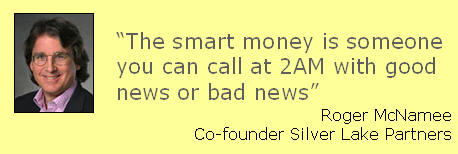
In fact many of the start-ups indicated that their VC money was still in the bank. In the session with Ram Shriram and Roger McNamee both agreed there is a lot of money out there for Web2.0 companies. After a question from a young entrepreneur on how much of her company to give up to VCs the question of smart money vs. dumb money came up. Roger pointed to Ram saying "he's the smart money." Roger went onto say the the best way to know the smart money is - If you can call (your investor) with good news or bad news at 2AM then that's the smart money. Ram shared his criteria for investment. He looks for the passion of the founders. If they have found a problem to solve and are passionate about solving it, then he's in. It's not a question of understanding the business plan. That can come later.
In the session with Jeff Bezos, Jeff explained that Amazon's biggest cost is idle time. This is why they are making Amazon's infrastructure available at a very low cost as services over the web. Some of the prices he mentioned.
S3 - 15 cents GB/month
EC2 - about $70/month
Alexa Web Search - 30 cents/1000 requests
The computing is completely elastic. In the future you will be able to send inventory to Amazon's warehouses with a webservices call. Later you can send specific items anywhere with another webservices call. This is further proof that you can easily leverage all of Amazon's infrastructure at very low cost to build your own company.
The other main theme was how convergence of media and the Internet is creating disruption. The buzz was all about Google's acquisition of YouTube and the problem of digital rights that exists every where user generated content is published. It seems a problem that can be solved with a lot less posturing then we're seeing. The rumor is that Google set aside $500M to pay for content rights in the YouTube acquisition. This video of Colbert makes the point.
Well I'm off to the Web2.0 conference in San Francisco. I'm really looking forward to it. Last year I signed up late and couldn't get in. This year I made sure to sign up early and fotunately made it in. I heard that 5000 people applied but didn't get in. Lucky me.
I've just concluded a prolonged engagement at Kabira as their Interim VP of Marketing. The project involved a deep dive into the world of high performance transaction processing. Miles away from my previous engagement with the ill fated PubSub and the blogosphere.
There is non-the-less a learning I take from both projects. That is that your marketing message must SAY ONE SIMPLE THING. While we marketers of high tech software know this to be true in practice it's not that easy. Especially if the software you develop has thousands of applications.
I have focused my marketing consultancy of helping companies find that simple positioning.
Many times this involves convincing the engineers to simplify their product from the car with the 4 steering wheels into something easier to drive. This is often hard as it means giving up some of the capabilities.
Yesterday's Mercury News had an interesting article about a number of new search / tagging services that are combining simple search with the ability to save the results including notes and share them with others. See the article by Matt Marshall here.
I took a look at two of the services, Jeteye and Kaboodle. As a long time user of del.icio.us I immediately understood the value.
There are number of new services like this stemming from the problem we all have in storing interesting information and then being able to retrieve it later. Kaboodle was created by Manish Chandra because he had trouble surfing the web for items he needed in refurbishing his home. Del.icio.us was created by Joshua Schachter because he was frustrated with the inadequacy of browser bookmarketing. Flickr's Caterina Fake brought the power of tagging to photos. Necessity is the mother of invention.
Of course we all understand this problem of find things and then wanting to make use of them later. It isn't just on-line information. Remember the last time you read an article put it down and now can't find it. Or hanging your pictures, you put down your hammer and now - where the heck is it? Or you put that important document in your filling cabinet and now you can't remember which folder.
Tagging helps with this because you can put any number of tags on the same item. This means however you are thinking of a particular item the moment you are looking for it you are much more likely to find it.
But there needs to be more than just tagging, and saving. As we move to Singularity we need to transition from searching to watching, finding to notification and have it all integrated into our immediate context and location.
Pundit Panel at Software 2006 I'm attending the Software 2006 conference in Santa Clara for the next 2 days. MR Rangaswami puts together this conference annually to discuss the state of the enterprise software business.
This morning Ray Lane gave his annual view of the software industry. Nothing new here but Ray always has some good insights. Some key points from Ray. Successful software companies have three attributes.
Low resistance to value (Clear value, immediately recognized with decision to start as a no brainer)
Viral TCO (customers pay after value is created to further viral adoption)
Viral Installability (one button install to be up and running)
Viral is what it's all about.
Unfortunately the conference has turned into a forum for Indian outsourcing. There maybe some Indian outsourcing companies that aren't here but I wouldn't know them.
This afternoon we suffered through 2 shameless corporate pitches by Dave DeWalt, President of EMC Software and Thomas Kurian, SVP of Middleware at Oracle. I've never heard someone use more words to say nothing.
Gabriel Treadway The phone rang. It was the call I was expecting from Chris, my oldest son. "Dad, he's here, " he said.
And just like that I'm a grandfather. Chris and his wife Maureen had their first born son, Gabriel, born March 24th, 2006 at 3:57 PM in Phoenix, Arizona. Gabriel is a big boy and measured in at 8 pounds 15 ounces and 20 1/2 inches.
It is amazing to me how technology has changed how we experience a life being born. Not long ago no one would know the sex of the expected child. The father in the waiting room ready with cigars to pass around.
Today with ultra sound and other technological advances we knew a lot about Gabriel even before he was born.
And so it was. Chris' call with the simple words, "Dad, he's here" brought it home to me. The miracle of life.
Snow covers 6 story tracking tower atop Mt Umhunum
Well spring might be just around the corner but it's snowing in Almaden Valley. With the jet stream coming in from Alaska the snow line came down below 1000 feet. Yesterday I toured the valley and got these photos.
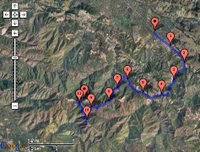
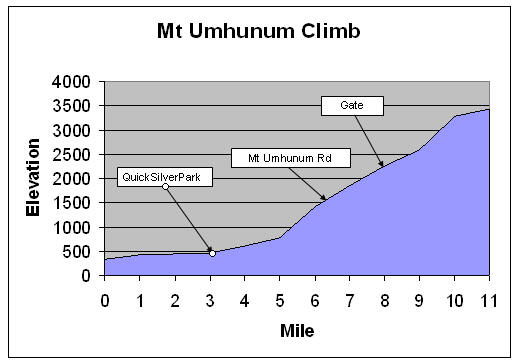
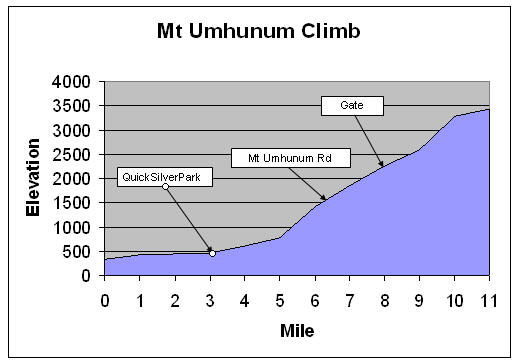
Today Jon and I rode up Hicks road to Mt Umhunum. A tough climb - 2500 verticle in 4 miles. They should put this climb in the Amgen Tour of California next year and have a hill top finish.
Route up Mt Umhunum
Climb Profile
There is a property owner that will not allow anyone to travel the section of Mt Umhunum road that goes through his property so it is impossible to ride all the way to the top of the military base and the 6 story tracking station at the top. This is most unfortunate as it would be a world class Hors Category climb at just under 3500 vertical feet in 8 miles with much of the climb at over 13%.
Today's San Jose Mercury News had an article by May Wong (AP) about how the market for flat screen TVs has opened to new brands that have used a Word-of-Mouth Internet marketing strategy. This shows the power that consumer recommendations can have in a commodity market.
"At Amazon.com, a 32 inch Olivia flat-panel LCD TV was recently the No.1 selling TV. The relatively unknown brand ranks in Amazon's top TV vendor list, helped by positive customer reviews, according to Amazon officials."
Discovery Leads the chase up Sierra Road - Stage 2
Today the Amgen Tour of California rode through our back yard. It really was a thrill to see the world's best cyclists hammering up the very hill I climbed just the day before. Sierra is a tough climb rising 2000 feet in under 4 miles. It took me 39 minutes to climb it. The pros would climb it in 20 minutes.
I had no idea just how big this event would be and I certainly was surprised. As we waited on Sierra for the race to arrive the road gradually began to fill with hundreds of spectators. Jon and I had positioned ourselves about 1/3 of the way up and found a good spot to catch the action. A steep right hand turn. From our vantage point we could see down to the intersection of Sierra and Piedmont roads where the racers would turn left and start the climb.
People with cell phones getting updates on the peleton's progress... They're 30 minutes away! Then suddenly the skies filled with helicopters, motor cycles, police cars honking their horns and camera crews all whizzing by. It was like an invasion. Then the leaders on the climb. Yes with the same cross eyed brain dead look that marks the absolute concentration required to climb a 13% grade at 13+ mph at your HRMAX. Savoldelli, Hindcapie, Simoni all fly by. WOW.
Here's more evidence that the web is moving from request-response to publish-subscribe.
As noted by Tom Biro, PR Newswire now has a button that enables readers to tag press releases with del.icio.us.
Steve Rubel takes this one step further in his post Social Press Releases with idea that if a press release were like a blog post it would enable a conversation through posted comments.
This points once again to the need for a new application that lets you be notified of puslished events that are material to you. As I discussed here that application is not an RSS reader.
Sitting on a rock at meditation point. What do you hear? What do you see?
Wind in your face to the south. Sun in your face to the north. The first day of spring. In with some rain. Out with some sun. Only the faint signs of life. Bird's song issuing the new bright green grass of spring.
Deep tracks in the hard baked mud of winter. Signs that there are other inhabitants you can't see, but certain they can see you.
Can you be still enough? Can you be observant enough? Can you be patient enough? Can you be quite enough? To hear and see and feel what you know is there.
After a difficult 2 weeks at work it's a great pleasure to enjoy an early leisurely morning outdoors having breakfast in the cool sun. Birds chirping. Sounds of the day awakening.
Each time I spend a morning like this it takes me back to my time in in Cassis, Provence. The early morning when the air is still cool, the wind is calm and the smell of pines is abundant.
It belongs to the early birds. Those that service the tourist industry, working diligently and efficiently to prepare for the new day. Cleaning the sidewalks, cafe tables and beaches in anticipation of the tourist onslaught.
Those moments of industry, so purposeful, so practiced, so efficient, followed by sleepy eyed tourists wondering about with no particular purpose but for that all important cup of coffee. It's a time when everyone can tell the tourist from the local.
Gradually the sun becomes stronger and the "cigals" start their chorus. You have to look hard to find the locals, their time of preparation spent, the tourist onslaught overwhelms them. The lazy moment of the wondering tourists ends as the early birds fly away into the mayhem of the crowed streets.